By Debi Lander
Long before Florida became American and waves of settlers arrived, a small Mediterranean community reshaped the cultural soul of St. Augustine. Their story is one of hardship, endurance and quiet influence. These were the Minorcans, along with Greeks and Italians, whose descendants still shape the city today.
A Failed Colony
In 1768, British physician Andrew Turnbull founded a plantation colony at New Smyrna, south of St. Augustine. To populate it, he recruited more than 1,400 laborers from the Mediterranean, primarily from the island of Minorca, along with settlers from Greece and Italy. Promised land and opportunity, they instead endured brutal conditions, disease, forced labor and harsh punishment.
After nine years of suffering, the surviving colonists—about 600 men, women and children—made a bold decision. In 1777, they abandoned New Smyrna and walked north to St. Augustine, then under British control. There, they sought protection from the governor, who granted them asylum and freedom.
That moment changed St. Augustine forever.
Building a New Life
The Minorcans settled primarily in the northern section of the walled city. They worked as fishermen, artisans, masons, carpenters and merchants, skills they brought from the Mediterranean. Over time, they became an essential part of the city’s economic and cultural life.
When Florida returned to Spanish rule in 1783, many British residents left. The Minorcans stayed. Because they were Catholic and spoke a Mediterranean language, they bridged the gap between the departing British and the returning Spanish, ensuring the city’s survival through turbulent political shifts.
Traces of the Past
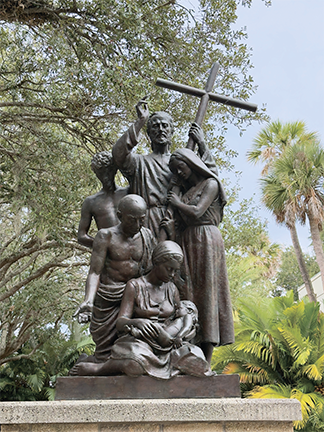
Today, the Minorcan legacy is everywhere. One of the most significant sites is the Father Pedro Camps statue in the west courtyard of the Cathedral Basilica. Father Camps was the spiritual leader of the group and helped lead the survivors to St. Augustine. The statue symbolizes moral courage and faith.
In a surprising discovery, that monument has a twin across the Atlantic. While visiting the island of Minorca, I found a replica of the Father Pedro Camps statue in the historic city of Ciutadella de Menorca. Cast in bronze on two continents, the statues link the Old World to the New and serve as bookends to the Minorcan journey.
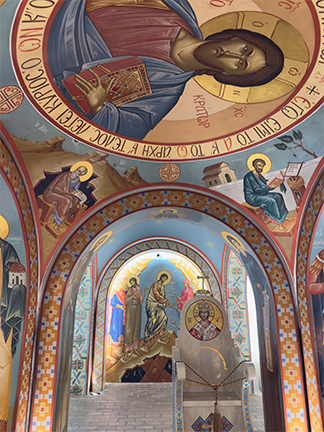
Along St. George Street, the St. Photios Greek Orthodox National Shrine stands on the site where Greek members of the colony found refuge. Its Byzantine-style murals and icons mark one of the earliest expressions of Orthodox Christianity in what would become the United States.
Other Minorcan-related sites include the Llambias House, the Gonzalez-Alvarez House and the Ximenez-Fatio House. At Tolomato Cemetery, familiar Minorcan surnames are carved into coquina headstones.
Minorcan cuisine remains one of the most visible survivals of the community. Datil pepper dishes, especially Minorcan clam chowder, reflect a blend of Mediterranean tradition and local ingredients still honored today.
A Quiet Legacy
The Minorcans did not arrive as conquerors or colonists by choice. They came as laborers, suffered deeply and rebuilt their lives through resilience and faith. Their legacy is marked not by grand monuments, but by homes, churches, cemeteries and family names woven into the fabric of America’s oldest city.about what it means to be an American today—and what kind of nation we want to be honoring when the tricentennial arrives.
Debi Lander is an award-winning travel writer and photographer who blends her passion for history, culture, food, and personal discovery into captivating stories. Through her website Bylandersea.com and her long-running travel column for Florida Newsline, she explores destinations from small U.S. towns to iconic global landmarks. She hopes her storytelling and practical insights inspire readers to experience the world with curiosity, appreciation, and a sense of adventure. Debi can be reached by email to mail@floridanewsline.com.